Philosophy of Technology
Spring 2026
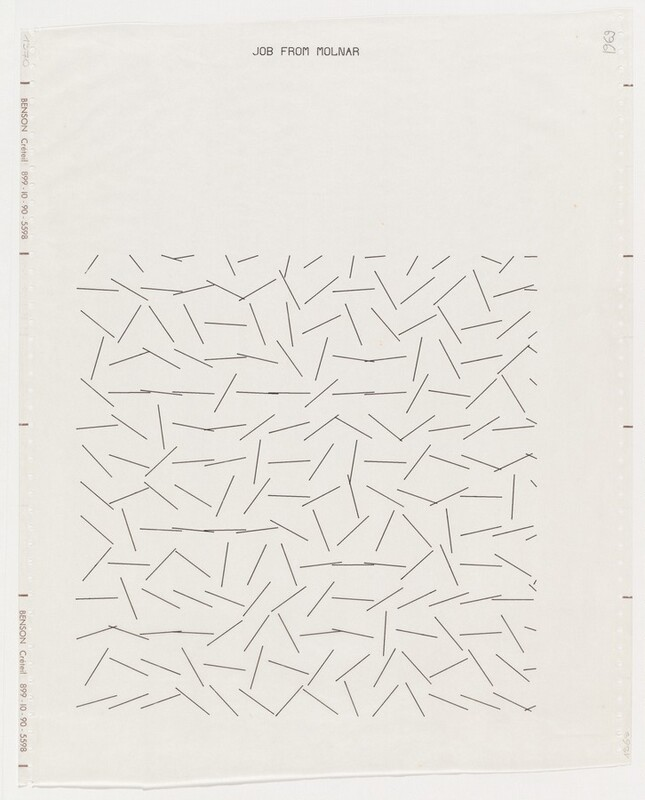
Vera Molnár, Interruptions, 1969.
Details
| Course Code | Location | Times |
|---|---|---|
| PHIL-SHU 130 | E203 | Tuesdays and Thursdays, 3:45pm to 5:00pm |
Instructor
| Name | Office | Consultation Times | |
|---|---|---|---|
| Brad Weslake | brad.weslake@nyu.edu | 567 West Yangsi Road, Room W826 | By appointment |
Overview
This is a course about artificial intelligence. First we focus on large language models, and consider whether they think, believe, understand, or know. Second, we consider how to tell whether an artificial system is conscious. Finally, we consider what to do when our capacity to build systems that make these good questions outstrips our capacity to give them good answers.
Assessment
The final grade will be determined approximately as follows:
| Attendance and participation: | 10% |
| In Class Exams: | 20% |
| Presentation: | 10% |
| Annotated Bibliography: | 20% |
| Paper (Outline): | 15% |
| Paper (Final): | 25% |
Assessment dates:
| Paper (Outline): | 17 April |
| Paper (Final): | 8 May |
Policies
Lateness and Attendance
Students are required to attend all classes on time. Lateness will count against your attendance and participation grade. Students missing 4 classes will receive an attendance and participation grade of F. Students missing 6 classes will receive a final grade of F.
Integrity
It is a condition on passing this course that students read and adhere to the NYU Shanghai policy on academic integrity as described in the current NYU Shanghai Academic Bulletin.
Course Materials
All notes, readings and assignments can be found on the course Brightspace site here.
Selected books are available on reserve in the library.
Schedule
Section 1: Artificial Cognition
Meeting 1: What is Cognition? (Tuesday 20 January)
In Class Reading
- Bayne, Tim and Brainard, David and Byrne, Richard W. and Chittka, Lars and Clayton, Nicky and Heyes, Cecilia and Mather, Jennifer and Ölveczky, Bence and Shadlen, Michael and Suddendorf, Thomas and Webb, Barbara. 2019. “What is Cognition?”, in Current Biology, Vol. 29, No. 13, pp. R608-R615. URI: https://doi.org/10.1016/j.cub.2019.05.044.
Meeting 2: Mind Design (Thursday 22 January)
- Haugeland, John. [1996] 1997. “What Is Mind Design?”, in Haugeland (Ed), Mind Design II: Philosophy, Psychology, Artificial Intelligence, MIT Press, Cambridge MA, pp. 1–28. URI: https://doi.org/10.7551/mitpress/4626.003.0001.
Meeting 3: The Turing Test (Tuesday 27 January)
- Turing, Alan M. 1950. “Computing Machinery and Intelligence”, in Mind, Vol. 59, No. 236, October, pp. 433–460. URI: http://doi.org/10.1093/mind/LIX.236.433.
Meeting 4: Psychologism and Behaviorism (Thursday 29 January)
- Block, Ned. 1981. “Psychologism and Behaviorism”, in The Philosophical Review, Vol. 90, No. 1, April, pp. 257–274. URI: https://doi.org/10.2307/2184371.
Meeting 5: The Chinese Room (Tuesday 3 February)
- Searle, John R. 1980. “Minds, Brains, and Programs”, in Behavioral and Brain Sciences, Vol. 3, No. 3, September, pp. 417–424. URI: http://doi.org/10.1017/S0140525X00005756.
Meeting 6: Escaping the Chinese Room (Thursday 5 February)
- Excerpt from Boden, Margaret A. 1988. Computer Models of Mind: Computational Approaches in Theoretical Psychology, Cambridge University Press, Cambridge.
- Excerpt from Block, Ned. 1995. “The Mind as the Software of the Brain”, in Smith and Osherson (Ed), An Invitation to Cognitive Science, MIT Press, Cambridge MA, Vol. 3: Thinking, pp. 377–426. URI: https://doi.org/10.7551/mitpress/3966.003.0016.
Meeting 7: Language Models I: Scepticism (Tuesday 10 February)
- Shanahan, Murray. 2024. “Talking about Large Language Models”, in Communications of the ACM, Vol. 67, No. 2, January, pp. 68–79. URI: http://dx.doi.org/10.1145/3624724.
Meeting 8: Language Models II: Bibliotechnism (Thursday 12 February)
- Yiu, Eunice and Kosoy, Eliza and Gopnik, Alison. 2024. “Transmission Versus Truth, Imitation Versus Innovation: What Children Can Do That Large Language and Language-and-Vision Models Cannot (Yet)”, in Perspectives on Psychological Science, Vol. 19, No. 5, September, pp. 874–883. URI: https://doi.org/10.1177/17456916231201401.
Spring Festival Holiday
Meeting 9: Language Models III: Interpretationism (Tuesday 24 February)
- Lederman, Harvey and Mahowald, Kyle. 2024. “Are Language Models More Like Libraries or Like Librarians? Bibliotechnism, the Novel Reference Problem, and the Attitudes of LLMs”, in Transactions of the Association for Computational Linguistics, Vol. 12, September, pp. 1087–1103. URI: https://doi.org/10.1162/tacl_a_00690.
Meeting 10: Language Models IV: Formal and Functional Competence (Thursday 26 February)
- Mahowald, Kyle and Ivanova, Anna A. and Blank, Idan A. and Kanwisher, Nancy and Tenenbaum, Joshua B. and Fedorenko, Evelina. 2024. “Dissociating Language and Thought in Large Language Models”, in Trends in Cognitive Sciences, Vol. 28, No. 6, June, pp. 517–540. URI: https://doi.org/10.1016/j.tics.2024.01.011.
Meeting 11: Language Models V: Worldly and Instrumental Knowledge (Tuesday 3 March)
- Paul, L. A. 2026. “Knowledge in Animals and Machines”, in Journal of Neuroscience, Vol. 46, No. 1, pp. 1–11. URI: https://doi.org/10.1523/JNEUROSCI.0939-25.2025.
Section 2: Artificial Consciousness
Meeting 12: (Thursday 5 March)
- Schwitzgebel, Eric. forthcoming. AI and Consciousness, Cambridge University Press, Cambridge, Chapter 1, “Hills and Fog”.
In Class Reading
- LeDoux, Joseph and Birch, Jonathan and Andrews, Kristin and Clayton, Nicola S. and Daw, Nathaniel D. and Frith, Chris and Lau, Hakwan and Peters, Megan A.K. and Schneider, Susan and Seth, Anil and Suddendorf, Thomas and Vandekerckhove, Marie M.P. 2023. “Consciousness Beyond the Human Case”, in Current Biology, Vol. 33, No. 16, pp. R832-R840. URI: https://doi.org/10.1016/j.cub.2023.06.067.
For Presentation
- Dehaene, Stanislas and Lau, Hakwan and Kouider, Sid. 2017. “What Is Consciousness, and Could Machines Have It?”, in Science, Vol. 358, No. 6362, October, pp. 486–492. URI: https://doi.org/10.1126/science.aan8871.
Meeting 13: (Tuesday 10 March)
- Schwitzgebel, Eric. forthcoming. AI and Consciousness, Cambridge University Press, Cambridge, Chapter 2, "What Is Consciousness? What Is AI?".
For Presentation
- Schwitzgebel, Eric. 2024. The Weirdness of the World, Princeton University Press, Princeton, Chapter 8, “Consciousness, Innocent and Wonderful”, pp. 173-188. URI: https://doi.org/10.1515/9780691239309-011
Meeting 14: (Thursday 12 March)
- Schwitzgebel, Eric. forthcoming. AI and Consciousness, Cambridge University Press, Cambridge, Chapter 3, "Ten Possibly Essential Features of Consciousness".
For Presentation
- Excerpts from Block, Ned. 1995. “On a Confusion About a Function of Consciousness”, in Behavioral and Brain Sciences, Vol. 18, No. 2, June, pp. 227–247. URI: http://doi.org/10.1017/S0140525X00038188.
Meeting 15: (Tuesday 17 March)
- Schwitzgebel, Eric. forthcoming. AI and Consciousness, Cambridge University Press, Cambridge, Chapter 4, "Against Introspective and Conceptual Arguments for Essential Features".
For Presentation
- Schwitzgebel, Eric. 2008. “The Unreliability of Naive Introspection”, in The Philosophical Review, Vol. 117, No. 2, April, pp. 245–273. URI: http://doi.org/10.1215/00318108-2007-037.
Meeting 16: (Thursday 19 March)
- Schwitzgebel, Eric. forthcoming. AI and Consciousness, Cambridge University Press, Cambridge, Chapter 5, "Materialism and Functionalism".
For Presentation
- Cutter, Brian. 2025. “The AI Ensoulment Hypothesis”, in Faith and Philosophy, Vol. 41, No. 1, January, pp. 1–26.
Meeting 17: (Tuesday 24 March)
- Schwitzgebel, Eric. forthcoming. AI and Consciousness, Cambridge University Press, Cambridge, Chapter 6, "The Turing Test and the Chinese Room".
For Presentation
- Schneider, Susan. 2021. Artificial You: AI and the Future of Your Mind, Princeton University Press, Princeton. URI: https://doi.org/10.1515/9780691197777, Chapter 4, “How to Catch an AI Zombie: Testing for Consciousness in Machines”, pp. 46-61.
Meeting 18: (Thursday 26 March)
- Schwitzgebel, Eric. forthcoming. AI and Consciousness, Cambridge University Press, Cambridge, Chapter 7, "The Mimicry Argument Against AI Consciousness".
For Presentation
- Andrews, Kristin and Birch, Jonathan. 2023. “What Has Feelings?”, in Aeon. URI: https://aeon.co/essays/to-understand-ai-sentience-first-understand-it-in-animals.
Meeting 19: (Tuesday 31 March)
- Schwitzgebel, Eric. forthcoming. AI and Consciousness, Cambridge University Press, Cambridge, Chapter 8, "Global Workspace Theories and Higher Order Theories".
For Presentation
- Dehaene, Stanislas. 2014. Consciousness and the Brain: Deciphering How the Brain Codes Our Thoughts, Penguin, New York, Chapter 5, "Theorizing Consciousness", pp. 161-199.
Meeting 20: (Thursday 2 April)
- Schwitzgebel, Eric. forthcoming. AI and Consciousness, Cambridge University Press, Cambridge, Chapter 9, "Integrated Information, Local Recurrence, Associative Learning, and Iterative Natural Kinds".
Qingming Festival Holiday
Meeting 21: (Tuesday 14 April)
- Schwitzgebel, Eric. forthcoming. AI and Consciousness, Cambridge University Press, Cambridge, Chapter 10, "Does Biological Substrate Matter?".
- Bisson, Terrry. 1991. “They’re Made Out of Meat”, in Omni, Vol. 13, No. 7, April, pp. 54.
For Presentation
- Block, Ned. forthcoming. “Can Only Meat Machines Be Conscious?”, in Trends in Cognitive Sciences. URI: https://doi.org/10.1016/j.tics.2025.08.009.
Meeting 22: (Thursday 16 April)
- Schwitzgebel, Eric. forthcoming. AI and Consciousness, Cambridge University Press, Cambridge, Chapter 11, "The Leapfrog Hypothesis and the Social Semi-Solution".
Section 3: Risk and Precaution
Meeting 23: Complacency (Tuesday 21 April)
- Birch, Jonathan. 2024. The Edge of Sentience: Risk and Precaution in Humans, Other Animals, and AI, Oxford University Press, Oxford, Chapter 15, "Against Complacency", pp. 299–312. URI: https://doi.org/10.1093/9780191966729.003.0016
Meeting 24: The Gaming Problem (Thursday 23 April)
- Birch, Jonathan. 2024. The Edge of Sentience: Risk and Precaution in Humans, Other Animals, and AI, Oxford University Press, Oxford, Chapter 16, "Large Language Models and the Gaming Problem", pp. 313–322. URI: https://doi.org/10.1093/9780191966729.003.0017
Meeting 25: The Run Ahead Principle (Tuesday 28 April)
- Birch, Jonathan. 2024. The Edge of Sentience: Risk and Precaution in Humans, Other Animals, and AI, Oxford University Press, Oxford, Chapter 17, "The Run Ahead Principle", pp. 323–331. URI: https://doi.org/10.1093/9780191966729.003.0018
Meeting 26: Sacrificing Humans for Insects and AI (Thursday 30 April)
- Schwitzgebel, Eric and Sinnott-Armstrong, Walter. forthcoming. “Sacrificing Humans for Insects and AI: A Critical Review of Jonathan Birch, The Edge of Sentience, Jeff Sebo, The Moral Circle, and Webb Keane, Animals, Robots, Gods”, in Ethics.
Meeting 27: Final Discussion I (Tuesday 5 May)
Meeting 28: Final Discussion II (Thursday 7 May)
Updated: 22 January 2026